Monty Hall Project Management

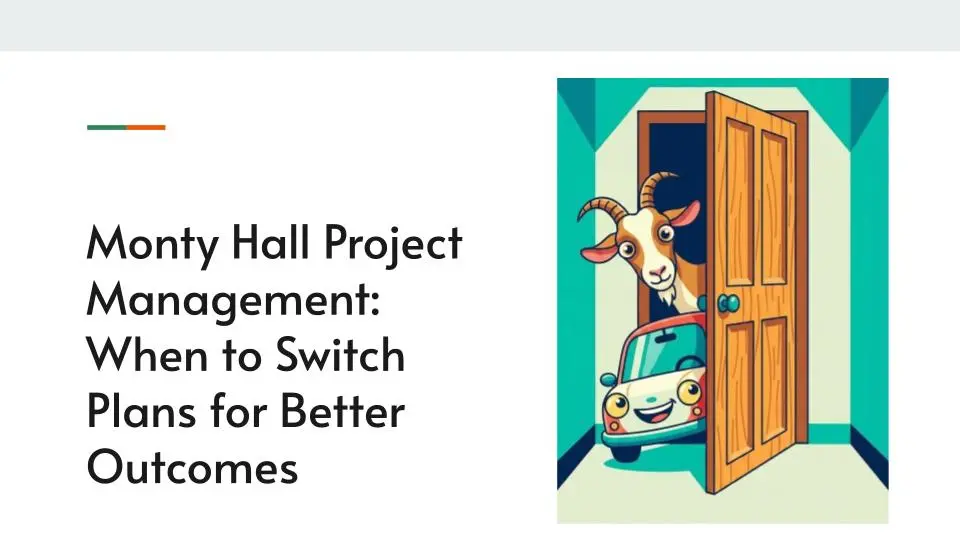
There are 3 doors, behind which are two goats and a car.
You pick a door (call it door A). You’re hoping for the car ofcourse.
Monty Hall, the game show host, examines the other doors (B & C) and opens one with a goat. (If both doors have goats, he picks randomly.)
Here’s the game: Do you stick with door A (original guess) or switch to the unopened door? Does it matter?
 By Cepheus - Own work, Public Domain, https://commons.wikimedia.org/w/index.php?curid=1234194
Have you been following a project plan and opened a door with a goat? Do you keep going with your original guess of how the project will go or do you switch plans?
I'll save you the math homework and tell you the answer; you should switch doors. Look up "Monty Hall Problem" to understand why it isn't a 50/50 chance you are wrong but a 2/3 chance you are wrong and therefore should switch.
Well, you don't have to take math at its word for your project because Juan José Leguía, Lisandro Martin, and Ze Han have cracked open multiple case studies and come to the same conclusion - mid-course adjustments lead to significant and lasting improvements in project ratings.
The study highlights that early interventions are particularly effective, as they allow teams to resolve bottlenecks while implementation structures remain flexible. Furthermore, Level I restructurings, which involve substantive changes to project objectives, yield more substantial performance gains than minor technical revisions. Ultimately, they argue that restructuring should be viewed as a proactive mechanism for adaptive management rather than a reactive sign of failure.
Here's a really great summary of their findings from Martin:
Does restructuring actually improve project performance?
The answer is yes, but when it behaves like a reflex, not a rescue.
Using panel data on World Bank projects and tracking Implementation Status and Results ratings over time, the analysis shows that restructurings are consistently associated with real, sustained improvements in performance, not cosmetic resets. The gains persist across reporting cycles, suggesting genuine changes on the ground.
But two behavioral insights stand out 👇
🔹 Timing matters. Early restructurings create space for learning to compound. Late ones can still help, but they are bounded by time, attention, and political capital. Feedback only works if it arrives while behavior can still change.
🔹 Depth matters. Substantive restructurings -those that truly revisit objectives, components, and results frameworks- outperform incremental tweaks. Small adjustments reduce friction; deep ones realign beliefs. This is where the Outcome Reflex comes in.
Restructuring works not just because it changes design, but because it changes behavior.
It interrupts inertia, counters sunk-cost bias, and creates institutional permission to ask the uncomfortable question: is this still working?
Seen this way, restructuring is not an admission of failure.
It is a credibility reset: a moment where evidence is converted into action, and where teams recommit because the plan once again feels feasible and worth investing in.
The broader lesson:Outcome-oriented institutions don’t rely on perfect plans. They build systems that notice drift early, respond decisively, and adapt seriously.
Neither too little. Nor too late.
Just in time and with intent.
Read the Paper
Martin, Lisandro; Leguia Alegria, Juan Jose; Han, Ze.
Neither Too Little, nor Too Late : Restructuring as a Reflex for Outcomes (English). Policy Research Working Paper;RRR;Prosperity Washington, D.C. : World Bank Group. http://documents.worldbank.org/curated/en/099846501092614804